
The London of Charles Dickens
“He had no further intercourse with spirits, but lived upon the total abstinence principle, ever afterwards; and it was always said of him that he knew how to keep Christmas well, if any man alive possessed the knowledge. May it truly be said of us, and all of us! And so, as Tiny Tim observed, God bless us, every one.”
The final paragraph, A Christmas Carol, 1843, Charles Dickens
As we look towards the festive season, Mr Londoner heads south across the river in search of the city Charles Dickens would have known.
It’s curious that today we remember Ebenezer Scrooge as a sad and curmudgeonly miser. It’s true old Scrooge begrudgingly gave his humble clerk, Bob Cratchit, Christmas Day off - albeit as unpaid leave. He then trudged grumpily home alone on Christmas Eve to his cold and spartan lodgings. However, on that fateful date, at the strike of midnight, the unhappy misanthrope’s life was to change for ever.
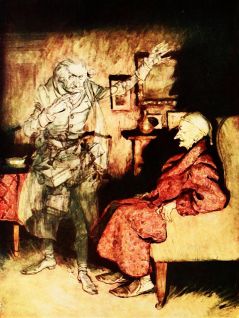 Ebenezer Scrooge was visited by three ghosts in A Christmas Carol
Ebenezer, through his encounters with the ghosts of Christmas Past, Present and Future, became a man transformed. Charles Dickens’s 1843 novella A Christmas Carol is a story of redemption. Like the history of London itself, this is a tale of re-invention. Its publication even inspired more enlightened Victorian industrialists, on both sides of the Atlantic, to become more caring employers, at least during the season of goodwill. A Christmas Carol presents a moving narrative and one that still packs a punch. This little book embodies the power of the Christmas message like few others and it has never gone out of print.
Insomniac
Some credit Dickens as being ‘The man who invented Christmas’. In truth, Yuletide customs, like cards and decorated trees, probably owe more to the adoption of German traditions, with the 1840 arrival of Prince Albert, as Consort to Queen Victoria.
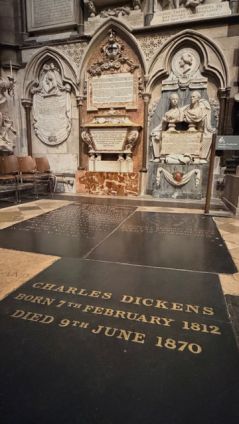 Charles Dickens's grave at Westminster Abbey @meetmrlondoner
However, when it comes to the life of Charles John Huffam Dickens (1812-1870) separating the man from the myth and the legend can prove problematic. The writer was famously insomniac. He loved to walk. He would amble through the dark streets of London at all hours, generating ideas for plots and people. Thanks to Dickens’s encounters during these perambulations, we have some vividly-realised characters. Consider the Artful Dodger in Oliver Twist; the terrifying convict anti-hero Magwitch, in Great Expectations - or the humorous but wordly-wise cockney manservant, Sam Weller, in The Pickwick Papers.
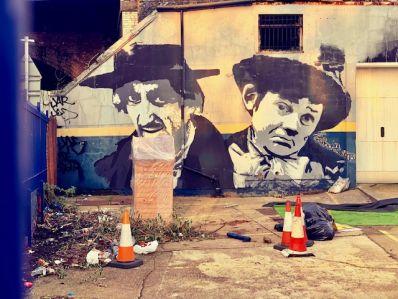 Fagin and the Artful Dodger from Oliver Twist depicted on a wall in Bankside @meetmrlondoner
The young Charles Dickens’s comfortable middle-class existence was dramatically overturned in 1824. His naval clerk father, John, fell into debt and was sent to the Marshalsea prison. Its forebodingly high stone walls can still be inspected at the southern end of Borough High Street to this day. The 12-year-old Charles lived in the prison, while being forced, on day-release, into unrelentingly grim work at a Charing Cross boot-blacking factory. This seminal experience sparked Dickens’s crusading zeal, spotlighting the fractured lives and the stark realities of the daily grind for the urban poor.
These were the formative experiences that forged the literary career of the man who became London’s biographer. Over 20-years, Dickens edited a weekly journal and penned 15 novels. His first, The Pickwick Papers, published in 1836, made his name. He wrote his stories in instalments, often with cliffhanger endings, keeping an enraptured public in nail-biting suspense.
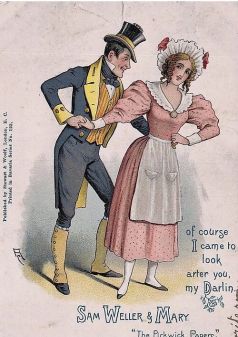 Sam Weller and Mary from The Pickwick Papers, 1903
Dickens also produced five novellas and hundreds of short stories. He enjoyed lecture tours in Britain and America. Remaining a tireless correspondent throughout his life, Dickens campaigned vigorously in support of education and social reform until his death, in 1870. At Queen Victoria’s insistence, Charles Dickens was buried in the medieval floor of Westminster Abbey’s Poets’ Corner. The grave was left open overnight for people to pay their final respects. Poor mourners left touching posies of hand-picked flowers - so many in fact that the Abbey’s churchwardens struggled to close the hefty granite tombstone.
Gentrified
It’s hard now, among London’s eye-wateringly expensive and gentrified real-estate, to picture a city of workshops, factories and smoking stacks. In Southwark, just south of the river, Bermondsey, Borough and Bankside have re-invented themselves as desirable neighbourhoods. No longer dominated by soot and squalor, they promote quality hospitality and the cutting-edge of our creative industries. This is the place to sample gourmet street food at Borough Market, or craft beer and artisan saké in a Bermondsey railway arch. Alternatively, if culture is on the agenda, one might enjoy a play at Shakespeare’s Globe or immerse oneself in the art of Tate Modern. This world-leading gallery is housed in what was once Bankside’s imposing power station. How this corner of London has changed.
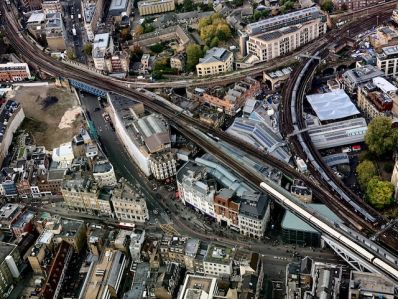 To this day, Bermondsey, Borough and Bankside are dominated by Victorian railway lines @meetmrlondoner
Despite this transformation, the neighbourhood still celebrates a little of the grit in the oyster. And there remain tantalising clues to Southwark’s industrial past. London Bridge and Bermondsey have monastic origins. The area developed a strong woollen industry. Later, food processing became a major local employer. By Victorian times, Southwark was home to ‘the smelly industries’ of leatherwork; parchment-making; brewing; glue-boiling; vinegar distillation and hat-making. The resultant foul and toxic air and insanitary conditions became infamous.
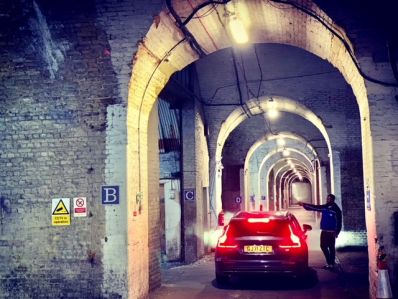 Southwark is still dominated by Victorian railway viaducts and tunnels @meetmrlondoner
Hat-making involved the use of mercury, inflicting debilitating illnesses on local workers. This is where we derive the phrase ‘Mad as a hatter’. Bermondsey was home to Christy’s. Established in 1773, the hat company is still going although male demand for headwear has steadily declined. During the 1960s, style-setting President John F Kennedy (a man with an impressive head of hair) no longer wore a hat. Even 007’s signature trilby disappeared from the iconic gun-barrel credits of the early Bond films.
Tanneries
Among Bermondsey’s smelliest industries were the tanneries. This working-class corner of south London made very high-quality leather. And nothing was wasted during Victorian times. Urine and faeces (known euphemistically as pure) were collected by unfortunate workers dubbed pure-finders. This readily-available raw material was used to help purify and soften leather hides. Little wonder Dickens spoke of the air “reeking of evil smells”.
Local architect and surveyor George Elkington built the beautiful old London Leather, Hide and Wool Exchange in 1878. It still stands on the corner of Weston and the aptly-named Leathermarket Street. Described as ‘an ornament to the district’, beautifully-executed stone roundels in its walls depict the leather-making process in some detail.
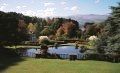
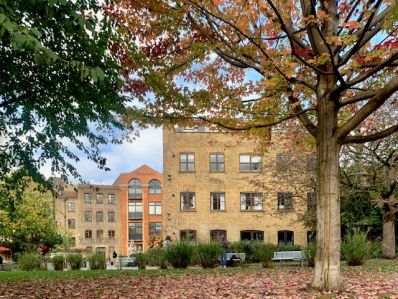 Autumn leaves in Bermondsey Spa Gardens @meetmrlondoner
Bermondsey leather was used for book-binding and later for clothing. During the Second World War, the Grange Tanneries, alongside other local manufacturers, produced the leather for aviators’ gloves and helmets. It made the now (much-sought after by collectors) Royal Air Force ‘Irvin’ flying jacket. This fleece-lined cropped number was made famous by Battle of Britain flyers. It has been re-interpreted by the fashion industry ever since.
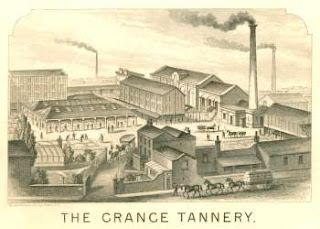
The Grange Tannery was opened in 1876. Water from the nearby River Thames was essential for the tanning process. Originally run by Samuel Barrow & Brothers, Grange re-branded as Barrow, Hepburn & Gale, one of the largest firms in the area. The tannery and its factory were destroyed in 1940 by enemy action. As part of post-war re-development, the bomb site was one of the first to be converted into a public park. Leathermarket Gardens is today celebrated for its beautiful roses.
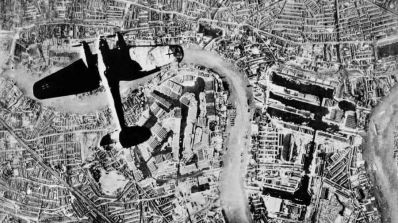 Bermondsey, an industrial area near London's docks was targeted during the Blitz, in World War Two. (Photo: Imperial War Museum.)
Just around the corner is The Horseshoe Inn. This is a proper locals’ pub. It’s tucked away in a corner plot in a quiet backwater on Melior Street. It’s also the perfect spot for a pint of golden Christmas ale or a steaming glass of mulled wine. Our well-earned reward at this, the end of our journey, provides a moment to reflect on the history of this atmospheric corner of London. Just like Ebenezer Scrooge’s own story, this too is a tale of transformation, reinvention - and perhaps even redemption.